The Main Types of Blowers by Power Source
When you evaluate blowers for your distribution catalog or retail shelves, the most reliable way to categorize them is by their power source. The power delivery system directly dictates a tool’s mobility, working radius, maintenance demands, and compliance with local municipal regulations.
Cordless Battery Blowers
Cordless battery blowers represent the fastest-growing segment across both residential gardening and light trade maintenance. Powered by high-capacity lithium-ion battery platforms—most notably 20V Max systems—these tools free operators from tangled extension cords and smelly fuel mixtures.
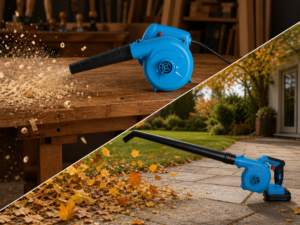
The primary commercial advantage of cordless units is instant startup and unrestricted portability. Your customers can easily clear driveways, rooftop gutters, or parking perimeters with a simple trigger pull. Fitted with an extended sweep tube, an ergonomic cordless leaf blower lets homeowners clear lawn foliage from an upright posture, while compact handheld configurations allow trade contractors to blow fine dust and sawdust out of tight jobsite corners. Furthermore, modern battery engineering produces minimal motor noise and zero direct emissions, making these units fully compliant with strict suburban noise bylaws and urban environmental policies.
While runtime depends on battery capacity (typically 15 to 30 minutes of high-speed blowing per 4.0Ah pack), stocking tools that share a 20V one-battery-for-all platform allows your customers to interchange batteries seamlessly between blowers, cordless drills, and impact wrenches without buying redundant chargers.
Corded Electric Blowers
For customers who prioritize non-stop runtime and budget-friendly pricing, the corded electric blower remains an indispensable workhorse with steady global demand. Operating on standard 110V–120V or 220V–240V alternating current (AC), these tools deliver consistent, non-fading blowing force as long as they are plugged into an outlet or portable generator.
Because corded units do not carry the deadweight of heavy battery packs or internal combustion engines, they are exceptionally lightweight, significantly reducing wrist fatigue during prolonged cleanup sessions. In the commercial trade, the most iconic and highest-volume application for this power source is the workshop dust blower (typically rated between 400W and 600W). Built with a compact body and a flexible rubber nozzle, it delivers high static air pressure to dislodge stubborn wood shavings, metal dust, and machinery filings from carpentry tables and electronic enclosures. Many models also feature dual-port versatility: moving the nozzle to the lateral intake and attaching a dust collection bag instantly turns the unit into a practical benchtop vacuum.
For budget-conscious homeowners with small paved yards or patios, a corded electric blower also offers an affordable, maintenance-free way to sweep leaves without battery degradation. The main operational boundary you need to communicate to buyers is cord reach, which limits working radius to within 50 to 100 feet of an electrical outlet.
Gas Powered Blowers
Gas powered blowers (commonly called petrol blowers) are driven by compact two-stroke internal combustion engines. They remain the heavy-duty benchmark for commercial landscaping contractors, municipal groundskeeping, and extensive agricultural acreage where grid electricity is completely inaccessible.
The unmatched strength of a petrol engine is raw kinetic energy and all-day endurance. A full tank of fuel provides extended continuous runtime, and refueling takes only seconds at the jobsite, eliminating battery charging downtime during peak seasonal cleanups.
Commercial buyers frequently seek multi-functional configurations, particularly the 3-in-1 blower vacuum mulcher (also known as a blower, vacuum, and shredder). These heavy-duty units do far more than sweep leaves into piles:
Blow: Delivers high-velocity air streams to herd thick, scattered debris across expansive fields. Vacuum: Reverses the airflow through a wide suction chute to collect loose leaves and garden waste directly. Mulch / Shred: Internal high-speed steel impellers grind incoming foliage down at reduction ratios of 10:1 to 16:1, compressing bulky yard waste into compact, nutrient-rich mulch that fits easily into collection bags or compost bins.
If your target market covers rural acreage or commercial contracting, stocking petrol blower is essential. However, keep in mind that petrol equipment requires routine maintenance: operators must mix two-stroke oil and gasoline correctly, clean spark plugs, and maintain air filters. Their louder operating decibels and exhaust fumes also limit their appeal in dense suburban neighborhoods.
Essential Performance Specs and Design Features
Selecting the right blower models requires looking past cosmetic shell designs and understanding core aerodynamic specifications. To help your retail or trade clients select the best equipment, focus on these four foundational performance metrics.
Air Volume: CFM Explained
CFM stands for Cubic Feet per Minute. It measures the total volume of air passing through the blower nozzle every sixty seconds.
When advising your buyers, think of CFM as the blower’s “sweeping width” or payload capacity:
A lower CFM rating produces a narrow air stream suitable for light bench cleaning or sweeping dry dust off walkways.
A high CFM rating creates a broad, voluminous wall of air capable of pushing massive piles of dry autumn leaves, hedge trimmings, and grass clippings across open lawns in broad, efficient passes.
For residential yard work, ratings between 250 and 450 CFM handle regular lawn maintenance easily. Commercial contractors tackling large properties and municipal parks typically require 500 to 700+ CFM to move heavy seasonal debris with minimal passes.
Air Velocity: MPH Explained
MPH stands for Miles per Hour. It measures the physical speed at which air exits the tip of the blower nozzle.
If you imagine CFM as the volume of a sweeping air wave, MPH represents its penetrating impact force:
High air velocity is essential for dislodging wet, heavy leaves and compacted pine needles plastered to wet asphalt or lawn turf.
In mechanical and industrial settings, high MPH provides the focused kinetic punch needed to peel sticky sawdust and metal shavings out of narrow machine grooves and conveyor tracks.
The most effective blowers balance both numbers: sufficient MPH to unseat stubborn debris, backed by ample CFM to roll the loosened pile across the ground.
Fan Housing Design: Axial vs. Centrifugal
The internal fan geometry determines whether a blower specializes in high air volume or high air pressure:
Axial Fan (Jet Fan) Design: Air is drawn straight in and propelled forward parallel to the motor shaft, just like a commercial jet engine. This low-resistance, direct-flow configuration generates tremendous air volume (CFM) with high efficiency. It is the gold standard for modern outdoor leaf blowers designed to sweep expansive lawns quickly.
Axial Fan (Jet Fan) Design: Air is drawn straight in and propelled forward parallel to the motor shaft, just like a commercial jet engine. This low-resistance, direct-flow configuration generates tremendous air volume (CFM) with high efficiency. It is the gold standard for modern outdoor leaf blowers designed to sweep expansive lawns quickly.
Motor Efficiency: Brushless vs. Brushed
In electric and battery-powered blowers, motor architecture directly influences operational lifespan and battery endurance:
Brushed Motors: Use physical carbon brushes and a mechanical commutator to transfer electrical current. While economical and proven for light-duty or entry-level utility blowers, carbon brushes generate internal friction, heat, and wear over time.
Brushless Motors: Replace mechanical contacts with computerized electronic controllers and permanent magnetic rotors. By eliminating physical friction, brushless motors deliver up to 30% to 50% longer battery runtime per charge, produce less operating heat, maintain consistent speed under heavy air resistance, and offer a vastly extended service life under daily commercial use.
If you serve professional contractors, stocking brushless models is the most effective way to lower warranty return rates and protect your brand reputation.
Conclusion
From clearing fine carpentry dust off workshop benches to sweeping dense autumn leaves across large estates, understanding the operational tradeoffs between cordless battery mobility, corded continuous power, and heavy-duty petrol versatility allows you to build a balanced, fast-turning inventory.
When establishing your supply chain, working with a dependable one-stop tools supply partner ensures your business remains protected in competitive markets. FIXTEC Tools supports international distributors and brand importers with verified CE, GS, EMC, RoHS, and ETL international certifications, guaranteeing full regulatory compliance across European and North American borders. To safeguard your cash flow and capture peak seasonal demand without delay, we maintain substantial finished inventory enabling fast dispatch within 7 business days. Ready to expand your catalog with high-margin, reliable power air blower? Explore our complete blowers range or contact FIXTEC today for full product specifications and wholesale quotations.
FAQ
1. What is the main difference between a dust blower and a leaf blower?
The main difference lies in fan design and targeted application. A compact dust blower uses a centrifugal impeller and a narrow nozzle to generate high air pressure (MPH) for clearing machine dust in confined workshops. A leaf blower uses an axial jet fan and an extended tube to produce voluminous airflow (CFM) for sweeping wide outdoor lawns and driveways from an upright posture.
2. What warranty and spare parts support does FIXTEC provide for wholesale orders?
FIXTEC provides a 1-year commercial warranty alongside allocated free wearable spare parts with container orders. This package includes high-frequency replacement components such as switches, nozzles, and carbon brushes, backed by technical exploded-view diagrams to ensure seamless local after-sales maintenance.
3. Can wholesale buyers consolidate different blowers and power tools in a single order?
Yes, multi-category mixed container consolidation is fully supported. Importers can combine cordless blowers, corded workshop models, and petrol units with drills, angle grinders, and hand tools from our 2,500+ SKU catalog in a single shipment. This enables distributors to test new seasonal lines with flexible, low MOQs without tying up capital in full container loads of a single tool.
4. Does FIXTEC offer exclusive regional distributorship and showroom branding support?
Yes, regional exclusivity is available for qualified long-term distribution partners. To protect our partners’ market investments and profit margins, FIXTEC provides territory protection, branded showroom display racks, and point-of-sale marketing materials once annual purchasing commitments are established.